BMS & IBMS Solutions

ALMARA BMS & IBMS CAPABILITY

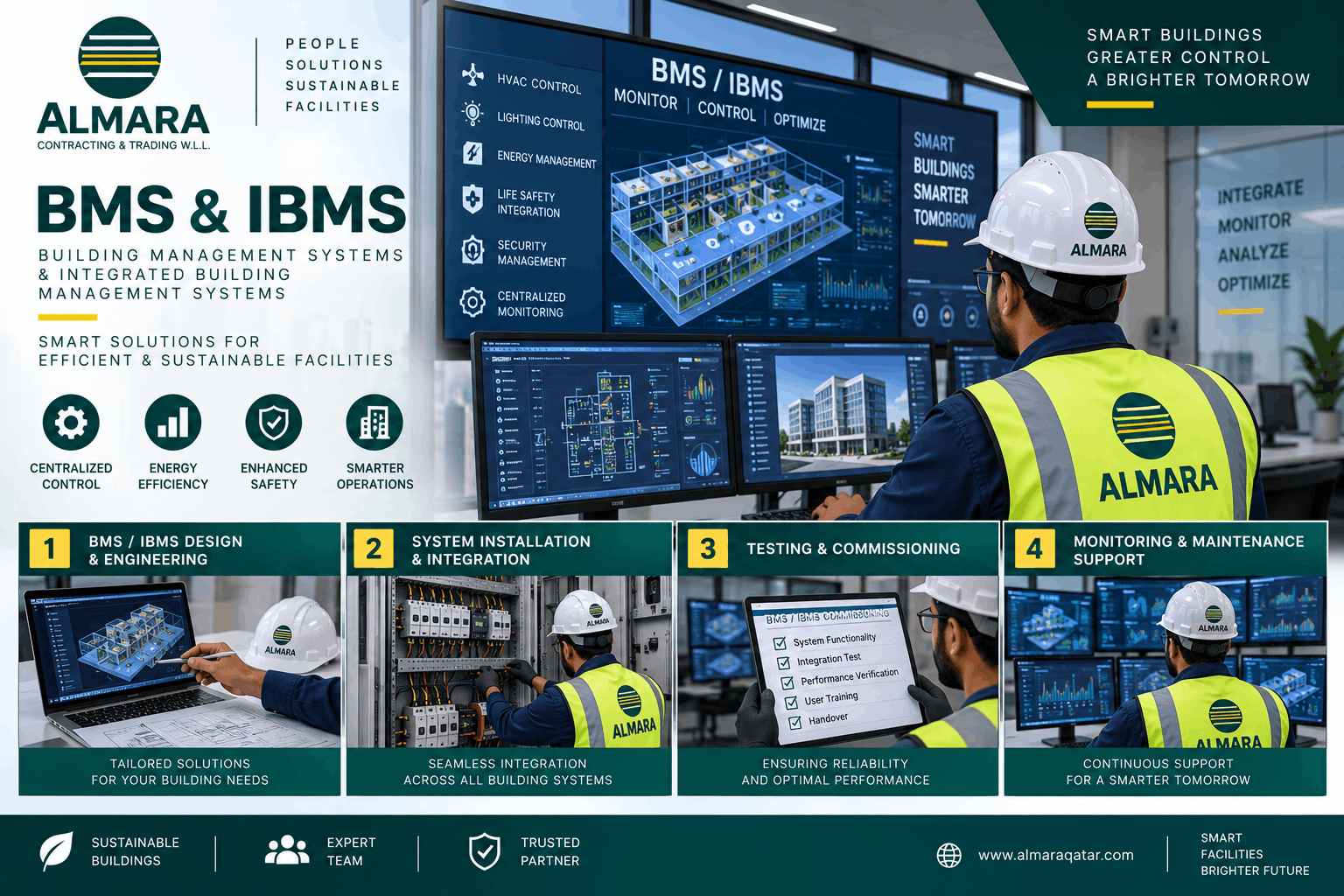
ALMARA provides Building Management System (BMS) solutions that centralize monitoring, control, automation, energy management, fault detection, reporting, and integration of building services. Building on ALMARA’s published BMS scope, our BMS/IBMS offering can be presented as a complete engineering, installation, integration, testing, commissioning, handover, and support service for modern residential, commercial, hospitality, healthcare, infrastructure, and mixed-use facilities.

BMS-&-IBMS-solutions
WEBSITE POSITIONING ALMARA’s current website specifically states BMS System Installation, Testing & Commissioning and lists centralized monitoring & control, energy management, ELV integration, smart scheduling, fault detection & alerts, and reporting & analytics. This document expands that published scope into a detailed BMS/IBMS service description suitable for the ALMARA website.

1. Bms & Ibms Design And Engineering

  • • BMS/IBMS system architecture and overall control philosophy.
  • • Development of system architecture, network topology, controller hierarchy, field-level controls and supervisory workstation structure.
  • • Preparation and coordination of BMS points lists, I/O schedules, equipment schedules, control schematics and sequence-of-operation documentation.
  • • Selection and coordination of DDC controllers, supervisory controllers, gateways, network switches, communication interfaces and associated control hardware
  • • Engineering coordination with HVAC, electrical, plumbing, fire & life-safety, ELV, security, lighting and other specialist systems.
  • • Review and coordination of approved MEP drawings, shop drawings, equipment submittals and manufacturer control requirements.
  • • Development of graphics, alarms, trends, schedules, reports, user access levels and operator interfaces.
  • • Design for new installations as well as upgrades, extensions and integration of existing building automation systems
  • 2. Bms / Ibms System Architecture

  • • Field devices and sensors connected to DDC/control panels.
  • • DDC controllers and application-specific controllers for HVAC and other monitored systems.
  • • Control panels, interface modules, relays, power supplies and communication equipment.
  • • Building-level automation networks and IP-based supervisory networks.
  • • Operator workstations, engineering stations and centralized supervisory software.
  • • Historical databases for alarms, events, trends, energy and operational data.
  • • Gateways and protocol interfaces for third-party equipment and systems
  • • Redundant or resilient architecture where required by project specifications
  • 3. Field Devices & Control Components

  • • Temperature, humidity, pressure, differential pressure and air-quality sensors.
  • • Flow, level and energy-metering interfaces as required by the control strategy.
  • • Control valves, damper actuators and variable-speed-drive interfaces.
  • • Current, voltage, power, energy and electrical status monitoring interfaces.
  • • Equipment run/status/fault feedback and enable/disable commands.
  • • Room thermostats, controllers and local operator interfaces.
  • • Field wiring, control cabling, labeling, termination and point identification.
  • • Calibration and verification of field devices before functional testing.
  • 4. Hvac & Mechanical System Integration

  • • AHU, FAHU, FCU, VAV and ventilation-system monitoring and control.
  • • Chiller, chilled-water pump, condenser-water pump and cooling-tower monitoring/control where applicable.
  • • VRF/VRV and packaged equipment integration through approved interfaces.
  • • Pump sets, heat exchangers, water systems and mechanical plant monitoring.
  • • Fan status, filter alarms, temperature/pressure monitoring and equipment fault indication.
  • • Start/stop control, setpoint management, scheduling and operating-mode control.
  • • Interlocks and sequences between associated equipment.
  • • Energy optimization through scheduling, setpoint management, load control and operational analytics.
  • 5. Electrical & Energy Management Integration

  • • Electrical meter and sub-meter monitoring.
  • • Monitoring of voltage, current, power, power factor, demand and energy consumption where supported.
  • • Integration of generator, UPS, ATS, electrical panels and other systems where specified.
  • • Monitoring of equipment status, alarms and selected electrical parameters.
  • • Energy dashboards, consumption trends, historical data and performance reporting.
  • • Time schedules and automated operating strategies to reduce unnecessary energy consumption.
  • • Coordination with electrical contractors for interface points, communication and testing.
  • 6. Elv, Security & Life-safety Integration

  • • Integration with approved ELV and specialist systems where required by project specifications.
  • • Interface with fire alarm systems for monitoring and approved cause-and-effect functions.
  • • Access control and security-system status integration where required.
  • • Lighting-control and DALI/BMS interface integration where specified.
  • • Centralized monitoring of selected alarms and system status.
  • • Coordination of interface signals, gateways, communication protocols and point mapping.
  • • All life-safety interfaces to be implemented strictly in accordance with approved design, authority requirements and the relevant specialist-system cause-and-effect philosophy.
  • 7. Bms / Ibms Communication & Protocol Integration

  • • BACnet/IP and BACnet MS/TP integration where specified.
  • • Modbus TCP/IP and Modbus RTU integration for meters, equipment and third-party controllers.
  • • Other approved/open protocols and gateways where required by the project.
  • • Protocol converters and gateways for equipment using different communication standards.
  • • Network addressing, device discovery, point mapping and communication verification.
  • • Third-party integration coordination with equipment manufacturers and specialist contractors.
  • • Communication-failure alarms and diagnostics where supported by the system architecture.
  • 8. Control Programming & Automation

  • • Programming of DDC controllers and application logic according to approved sequences of operation.
  • • Equipment start/stop, enable/disable and automatic/manual control logic.
  • • Temperature, pressure, humidity and other setpoint control strategies.
  • • Time scheduling, occupancy schedules and holiday calendars.
  • • Lead/lag, duty/standby and automatic changeover sequences.
  • • Equipment interlocks and permissive logic.
  • • Alarm generation, priorities, acknowledgement and escalation.
  • • Trend logging and historical data collection
  • • Optimization routines for operating efficiency and equipment performance.
  • • Operator access levels, user permissions and secure system operation.
  • 9. Graphics, HMI & Operator Workstation

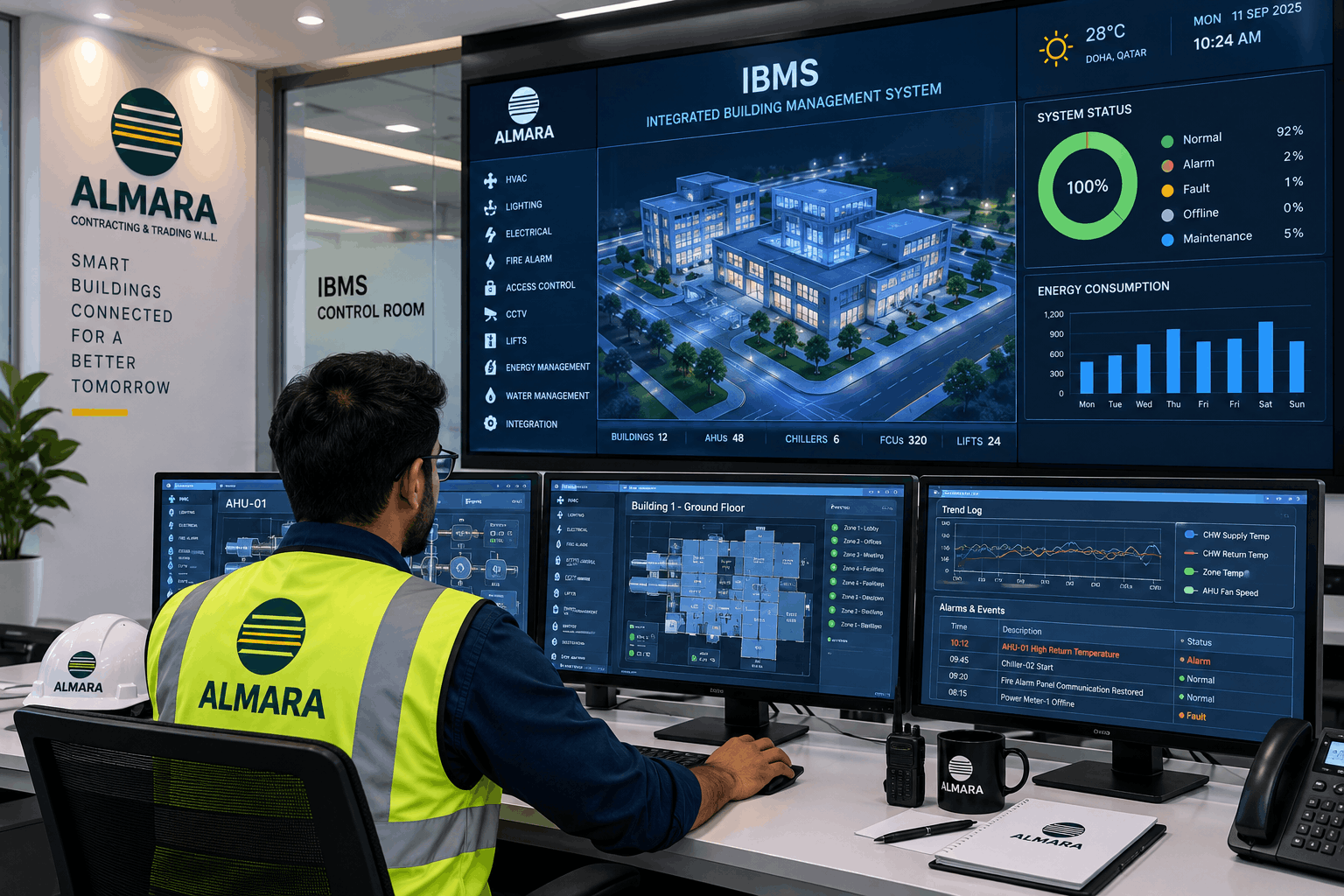
  • • Development of intuitive graphical floor plans, plant graphics and equipment pages.
  • • Dynamic display of equipment status, alarms, temperatures, pressures, setpoints and operating values.
  • • Navigation between buildings, floors, plant rooms, systems and equipment.
  • • Real-time alarm annunciation and event history.
  • • Trend graphs for selected parameters and energy data.
  • • Customized dashboards for facility operators and management.
  • • User login, role-based access and administrative controls.
  • • Reports for alarms, equipment operation, energy consumption and selected performance indicators
  • 10. BMS / IBMS Installation

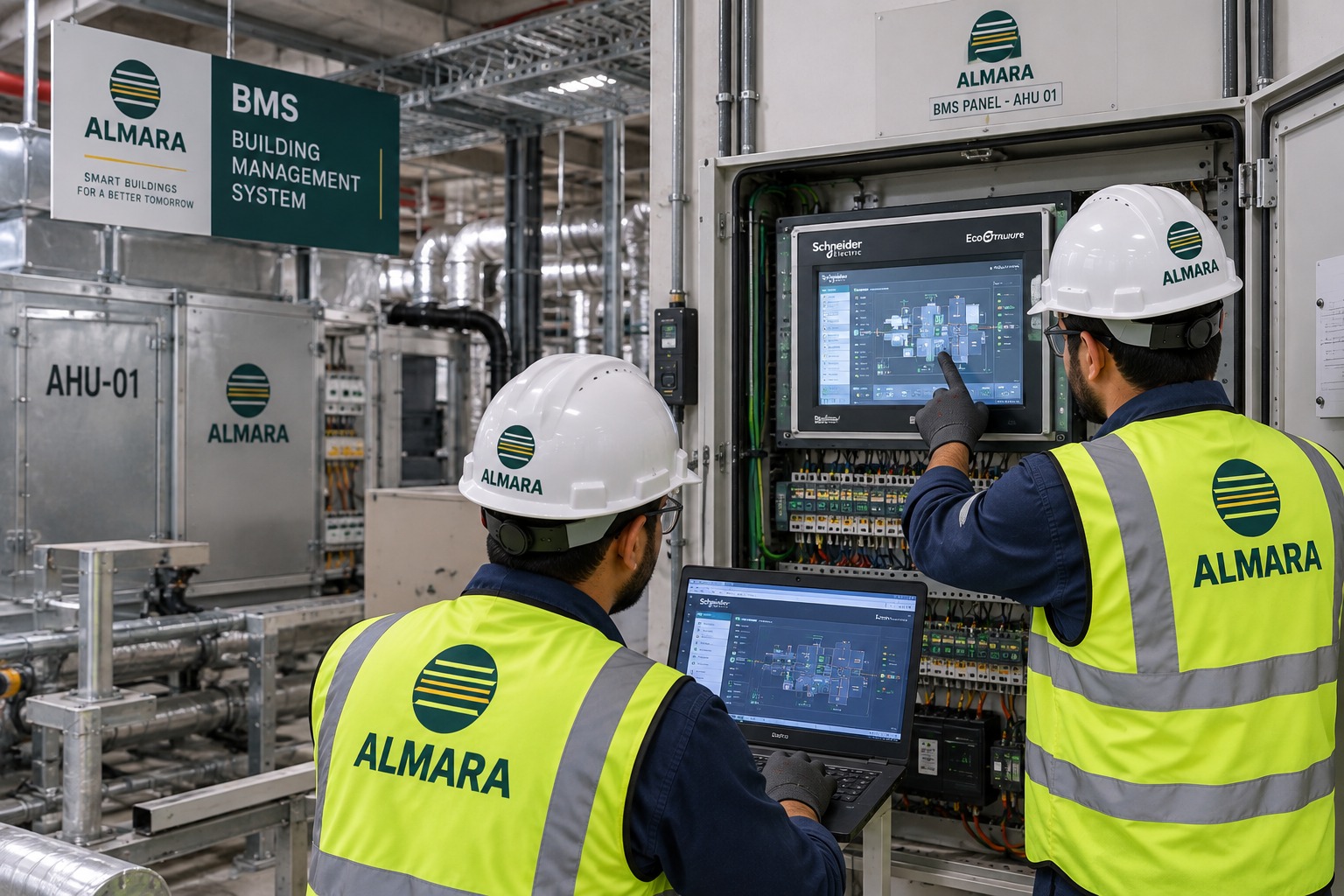
  • • Installation of BMS/DDC control panels and associated control hardware.
  • • Installation of controllers, gateways, network equipment and interface modules.
  • • Installation and connection of field sensors, actuators and control devices within the ALMARA scope.
  • • Control-cable routing, containment coordination, cable pulling, dressing, tagging and termination.
  • • Panel-side and field-side termination according to approved drawings and manufacturer requirements
  • • Installation of network cabling and communication interfaces.
  • • Panel labeling, point identification, cable labeling and as-built documentation.
  • • Coordination with HVAC, electrical, plumbing, ELV and specialist contractors to complete all interfaces.
  • • Inspection of installed equipment and rectification of installation defects before testing.
  • 11. Pre-commissioning & Installation Inspection

  • • Verification that installation matches approved shop drawings, schematics and I/O schedules.
  • • Inspection of panels, controllers, power supplies, wiring, terminals, labels and network connections.
  • • Verification of sensor and actuator installation, orientation, accessibility and identification.
  • • Continuity and termination checks for control and communication wiring as applicable.
  • • Verification of controller addressing, network configuration and communication links.
  • • Point-by-point review against approved point schedules.
  • • Verification that equipment is ready and available for functional testing.
  • • Preparation of pre-commissioning checklists and inspection records.
  • 12. Point-to-point Testing

  • • Verification of every BMS input, output, command, status, alarm and monitored value against the approved I/O schedule.
  • • Digital input verification: run status, fault status, proof signals and alarm conditions.
  • • Digital output verification: start/stop, enable/disable and relay commands.
  • • Analog input verification: temperature, pressure, humidity, flow and other measured values.
  • • Analog output verification: valve positions, damper positions and speed-control signals.
  • • Verification of correct point naming, engineering units, scaling, polarity and alarm configuration.
  • • Recording of test results and correction of failed or incorrectly mapped points.
  • 13. Functional Performance Testing

  • • Functional testing of each controlled item under normal operating conditions.
  • • Verification of automatic and manual operating modes.
  • • Verification of setpoints, schedules and occupancy modes.
  • • Testing of lead/lag and duty/standby changeover sequences.
  • • Testing of equipment interlocks and permissive sequences.
  • • Verification of alarms, alarm priorities, acknowledgement and reset functions.
  • • Testing of communication failure and equipment fault indications where applicable.
  • • Verification of trend logs, historical data and reporting functions.
  • • Testing of operator graphics against actual field equipment status.
  • 14. Integrated System Testing

  • • End-to-end testing between BMS/IBMS and connected MEP/ELV systems.
  • • Verification of HVAC and mechanical equipment interfaces.
  • • Verification of electrical monitoring and energy-metering interfaces.
  • • Verification of approved fire alarm and life-safety monitoring interfaces.
  • • Verification of lighting-control interfaces where included.
  • • Verification of third-party equipment gateways and protocol communications.
  • • Cause-and-effect testing for approved sequences and interlocks.
  • • Verification of trend logs, historical data and reporting functions.
  • • Coordination of integrated tests with all relevant specialist contractors, consultant and client representatives
  • 15. Commissioning

  • • Complete system startup following successful installation and pre-commissioning checks.
  • • Controller and software configuration verification.
  • • Final tuning of control loops, setpoints and operating sequences.
  • • Verification of all alarms, schedules, trends, graphics and reports.
  • • Functional performance testing under representative operating conditions.
  • • Optimization of sequences for comfort, reliability and energy performance.
  • • Resolution of commissioning observations and retesting of corrected items.
  • • Preparation of commissioning records, test sheets, point schedules and outstanding-item closure documentation.
  • 16. Final Handover & Documentation

  • • Approved/as-built BMS/IBMS drawings and system architecture documentation.
  • • Final I/O schedules and point lists.
  • • Controller and panel schedules.
  • • Network architecture and communication details.
  • • Final graphics and workstation configuration.
  • • Alarm, trend, schedule and report configuration records.
  • • Testing and commissioning reports.
  • • Equipment and device data sheets, manuals and manufacturer documentation.
  • • Operator and maintenance training.
  • • Final demonstration of system operation to the client/consultant.
  • • Handover of backups, software configuration and agreed system credentials/documentation in accordance with project requirements.
  • 17. Training & User Support

  • • Operator training for normal system operation.
  • • Training on alarm acknowledgement, trends, schedules and reports.
  • • Training on basic troubleshooting and system status checks.
  • • Training for engineering/administrative users where required.
  • • Provision of operation and maintenance guidance.
  • • Post-handover technical support and corrective assistance subject to the agreed service scope.
  • 18. Preventive Maintenance & Optimization

  • • Periodic inspection of controllers, panels, communication networks and field devices.
  • • Review of alarms, trends and system performance
  • • Sensor verification and recalibration where required.
  • • Review of control sequences and schedules.
  • • Database and graphics housekeeping.
  • • Backup of approved system configuration.
  • • Investigation of recurring alarms and communication faults.
  • • Energy-performance review and recommendations for optimization.
  • • Planned corrective maintenance and system upgrades as required.
  • 19. Almara Bms & Ibms Value To Clients

  • • Centralized visibility and control of building systems.
  • • Improved energy efficiency through automation, scheduling and monitoring.
  • • Enhanced occupant comfort and operational reliability.
  • • Faster identification of alarms, faults and abnormal operating conditions.
  • • Better coordination between MEP, ELV and building automation systems.
  • • Data-driven facility management through trends, reports and historical records.
  • • Scalable architecture for future extensions and system integration.
  • • Professional testing, commissioning and handover for reliable day-to-day operation.
  • Website-ready Summary

    ALMARA delivers complete BMS and IBMS solutions covering design and engineering, system architecture, field controls, installation, programming, integration, point-to-point testing, functional performance testing, integrated system testing, commissioning, handover, training and ongoing support. Our approach brings building systems together on a coordinated platform to improve visibility, comfort, safety, energy performance and operational control.

    Electrical Works → Powering Your Projects with Precision